poster
HomeProductsBall ValveV-Type Ball Valve
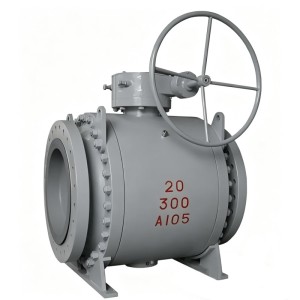
V-Type Ball Valve

V-Type Ball Valve

Structural Features

• V-shaped ball core: The hemispherical valve core has a V-shaped notch, which is the core component for regulation and shearing.

• Valve seat: It mates with the V-shaped notch to form a sealing surface. Soft seals (TFM, etc.) are suitable for clean media, while hard seals (welded or sprayed hard alloy) can be used in high-temperature, high-pressure, highly corrosive, or particulate-containing conditions.

Working Principle

• Regulation Function: As the valve core rotates, the overlap area between the V-shaped notch and the valve seat continuously changes, creating an equal percentage flow characteristic (opening degree and flow rate are logarithmically related), achieving high-precision control within the 30%-70% opening range.

• Shearing and Self-Cleaning: The V-shaped notch edge, in contact with the valve seat, cuts off fibers and small solid particles in the medium, preventing blockage; the relative movement between the valve core and valve seat during rotation scrapes away media residue on the sealing surface, achieving self-cleaning.

Product Description

Performance Parameters

• Nominal Diameter: 1"~24"
• Nominal Pressure: Class 150, 300LB
• Body Material: Carbon Steel (WCB), Stainless Steel (304/316), Special Alloy Materials
• Sealing Material: TFM, PEEK, Metal Seal


Application Scenarios

• Chemical Industry: Handling corrosive media containing fibers, slurries, or particles.

• Paper Industry: Flow regulation and shut-off of fibrous media such as pulp, black liquor, and white liquor.

• Petrochemical Industry: Working conditions involving high-viscosity media such as wax oil and residual oil, or media containing catalyst particles.

Online Inquiry

Related Products

Three-Way Ball Valve

Three-Way Ball Valve

Structural Features

• Valve body is a three-way structure with L- or T-shaped ports.

• The ball has an L-shaped or T-shaped channel.

• Mostly a floating ball structure; some large-diameter models are fixed ball.

• Common connections: threaded, flanged, welded, quick-connect.

• Actuation methods: manual, pneumatic, electric.

Thin Ball Valve

Thin Ball Valve

Structural Features

• Ultra-compact: 40%~60% shorter in length and 30%~50% lower in height than standard ball valves

• Lightweight: 30%~50% lighter, easier installation

• Connection: Mainly wafer type (clipped between two flanges), flange type is also available

• Opening and Closing: 90° rotation of the ball for quick shut-off/connection

• Low Flow Resistance: Full-bore design ensures smooth media flow and low pressure loss

• Excellent Sealing: Soft seal (PTFE/PPL) or metal seal, zero leakage

• Optional Features: Anti-static, fire-resistant structure, safety locking

Eccentric Hemispherical Valve

Eccentric Hemispherical Valve

Structure and Principle

• The valve core is hemispherical, with its rotation center eccentric to the valve body center.

• When open: The hemisphere disengages from the valve seat, resulting in no friction and low torque.

• When closed: The hemisphere presses against the valve seat, forming a line/surface seal.

• Typical structures: Side-mounted/Top-mounted, eccentric shaft, eccentric hemisphere.

Pneumatic Floating Ball Valve

Pneumatic Floating Ball Valve

Structural Features

• The ball has no lower support shaft; it is held only by the valve seats at both ends, allowing for slight floating under medium pressure.

• The valve stem is top-mounted, connecting to the ball, and is only responsible for rotation, not bearing axial pressure.

• Double-sided sealing: When closed, the ball is pushed towards the outlet valve seat by the medium pressure, forming a self-tightening seal.

• Simple structure: The valve body, ball, valve seat, valve stem, and stuffing box have few components, making maintenance convenient.

Working Principle

• Opening: Rotate the valve stem 90°, aligning the ball's through-hole with the pipeline, allowing smooth media flow.

• Closing: Rotate the valve stem 90° in the opposite direction, aligning the ball's through-hole perpendicular to the flow path; media pressure pushes the ball tightly against the outlet valve seat, with a tighter seal at higher pressures.

+86 19858780995

+86 19858780995

+86 19858780995

+86 19858780995

19858780995@163.com