poster
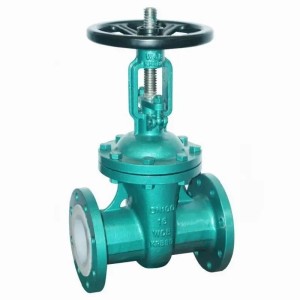
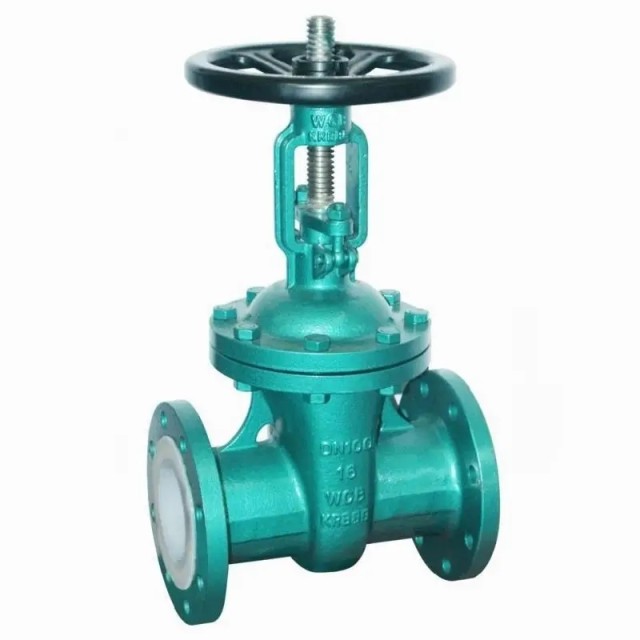
Fluorine-Lined Gate Valve

Fluorine-Lined Gate Valve

Working Principle:
The valve stem drives the gate to rise and fall vertically, controlling the flow of the pipeline; the medium only contacts the fluoroplastic lining layer and does not directly contact the metal valve body, completely isolating it from acid and alkali corrosion; it allows bidirectional flow without flow direction restriction, and is only used for switching off, not for throttling or regulating.

Product Description

Structural Features


1. Fully Fluorine-Lined for Corrosion Protection: The inner wall, gate, and seat are all lined with fluoropolymer, providing complete corrosion resistance and preventing media corrosion, rust, and leakage.

2. Minimal Flow Resistance: Straight-through design, large diameter, and low resistance, suitable for long-distance transport of corrosive fluids.

3. Excellent Sealing: Corrosion-resistant fluoroplastics combined with a soft seal ensure a tight, leak-free seal; wear-resistant, aging-resistant, and scale-free.

4. Robust Structure: The outer shell is made of cast steel/cast iron, providing high pressure resistance, while the inner fluoropolymer lining offers strong temperature and chemical resistance.

5. Easy Installation: Bidirectional flow, no installation direction requirements, flange connection, simple disassembly and maintenance.


Core Advantages


1. Resistant to strong acids, strong alkalis, strong oxidants, and organic solvents; extremely versatile.

2. Impermeable, corrosion-resistant, resistant to acids, alkalis, salts, and chemical solvents.

3. Media does not contact metal, extending the lifespan of valves and piping systems.

4. Fully open, non-erosion sealing surface; long service life.

5. No dead corners, less prone to material accumulation; suitable for corrosive wastewater and chemical liquids.

Materials and Parameters

• Valve body material: Cast iron, cast steel WCB

• Lining material: PTFE (F4), F46, PFA

• Pressure rating: PN10, PN16

• Applicable temperature: -20℃~180℃

• Connection method: Flange connection

• Drive method: Manual, electric, pneumatic


Applicable Media and Industries

Applicable media: Hydrochloric acid, sulfuric acid, nitric acid, liquid alkali, sodium hypochlorite, brine, corrosive wastewater, and various highly corrosive chemical fluids.

Application industries: corrosion-resistant pipelines in chemical, pharmaceutical, pesticide, electroplating, environmental desulfurization, wastewater treatment, pickling and phosphating, fine chemical and other industries.
Online Inquiry

Related Products

Check Valve

Check Valve

Working Principle: When the medium flows in the forward direction, the fluid pressure opens the valve disc/valve core, allowing the valve to open. When the medium flows in the reverse direction or the pressure reverses, the valve automatically closes and seals itself due to its own weight and the pressure of the reverse medium, completely blocking backflow without manual or electrical control.

Main Classifications and Structures:
1. Swing Check Valve: The valve disc swings around a pin. Commonly used in large-diameter applications, it has low flow resistance and smooth passage, suitable for water, steam, and oil.

2. Lift Check Valve: The valve disc moves vertically up and down along the valve stem, providing better sealing performance. Often used in small-diameter, high-pressure applications.

3. Wafer Check Valve: Ultra-thin structure, small size, low cost. It is clamped between two flanges for easy installation.

4. Butterfly Double-Disc Check Valve: Double-disc structure, sensitive opening and closing, good buffering, suitable for large-diameter water supply and drainage, and industrial pipelines.

5. Silent Check Valve: With a buffer structure, it reduces water hammer and noise. Commonly used in buildings and pump rooms.

Fluorine-Lined Gate Valve

Fluorine-Lined Gate Valve

Basic Definition: A fluoropolymer-lined gate valve is a forced-seal shut-off valve in which the inner surfaces of the valve body, cover, disc, and seat—all in contact with the medium—are entirely lined with a layer of fluoroplastic (PTFE/FEP/PFA/TFM, etc.). Its core structure combines metal load-bearing with fluoroplastic corrosion protection.

Core Structure:
• Valve Body/Cover: Carbon steel/stainless steel shell, lined with fluoroplastic
• Valve Disc/Seat: Fully fluoropolymer-lined, flat/conical seal, axially moving
• Valve Stem: Rising stem or rising/rotating stem, with packing seal
• Actuation: Manual, worm gear, pneumatic, electric

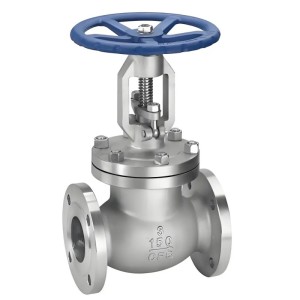
Gate Valve

Gate Valve

Working Principle: The medium flows in from below the valve seat, passes through the throttling gap between the valve disc and the valve seat, and flows out from the outlet. The valve disc stroke is controlled by the rise and fall of the valve stem, changing the flow cross-sectional area to achieve both shut-off and throttling. When closed, the axial pressure of the valve stem presses against the sealing surface to achieve a tight seal.

Structural Features:
1. Unidirectional Flow: Medium enters from a lower position and exits from a higher position; cannot be installed in reverse, requiring directional control during installation.

2. Good Sealing Performance: Plane/conical surface seal, tight closure, low leakage.

3. Excellent Throttling Performance: Controllable stroke, suitable for small-amplitude pressure and flow adjustment.

4. Relatively High Flow Resistance: S-shaped flow path in the pipeline, resistance coefficient higher than gate valves and ball valves.

5. Short opening and closing stroke, simple structure, convenient maintenance and replacement of parts.

Forged Steel Gate Valve

Forged Steel Gate Valve

Jīběn jiégòu duàn gāng zháfá shì yī zhǒng guānbì jiàn (zhá bǎn) yán tōnglù zhōngxīn xiàn chuízhí fāngxiàng yídòng de fámén, qí qǐ bì jiàn wèi zhá bǎn, yùndòng fāngxiàng yǔ liútǐ fāngxiàng chuízhí, tōngcháng jǐn yòng yú quán kāi huò quán guān, bù jùbèi tiáojié huò jié liú gōngnéng. Duàn gāng zháfá de zhá bǎn tōngcháng jùyǒu liǎng gè mìfēng miàn, zuì chángyòng de móshì zhá bǎn fá mìfēng miàn xíngchéng xiēxíng, xiēxíng jiǎo suí fámén shēn shù ér yì. Zhǔyào cānshù • gōngchēng yālì:PN16~PN160, shì pèi gāoyā, gāowēn gāoyā gōng kuàng • gōng chèn tōng jìng:DN15~DN200, yǐ xiǎo kǒujìng gāoyā guǎndào wéi zhǔ • gōngzuò wēndù: Tàn gāng-29℃~425℃; bùxiùgāng/héjīn gāng kě nài shòu 600℃yǐshàng gāowēn • fá tǐ cáizhì:A105,304,316L,F11,F22 děng zhěngtǐ duànzào cáizhì • mìfēng děngjí: Yìng mìfēng, ruǎn mìfēng kě xuǎn, mìfēng xìngnéng wěndìng, nài yā xìng qiáng
展开
291
Basic Structure A forged steel gate valve is a valve in which the closing element (gate) moves perpendicular to the centerline of the flow path. Its opening and closing element is the gate, and its movement direction is perpendicular to the fluid direction. It is typically used only for fully open or fully closed applications and does not have regulating or throttling functions.

The gate of a forged steel gate valve usually has two sealing surfaces. The most common type of gate valve has a wedge-shaped sealing surface, and the wedge angle varies depending on the valve parameters.

+86 19858780995

+86 19858780995

+86 19858780995

+86 19858780995

19858780995@163.com