poster
Check Valve

Check Valve

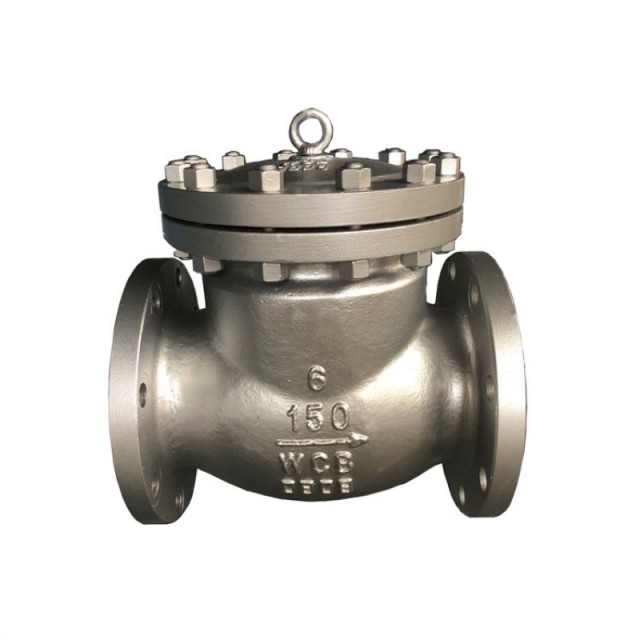
Working Principle: When the medium flows in the forward direction, the fluid pressure opens the valve disc/valve core, allowing the valve to open. When the medium flows in the reverse direction or the pressure reverses, the valve automatically closes and seals itself due to its own weight and the pressure of the reverse medium, completely blocking backflow without manual or electrical control.

Main Classifications and Structures:
1. Swing Check Valve: The valve disc swings around a pin. Commonly used in large-diameter applications, it has low flow resistance and smooth passage, suitable for water, steam, and oil.

2. Lift Check Valve: The valve disc moves vertically up and down along the valve stem, providing better sealing performance. Often used in small-diameter, high-pressure applications.

3. Wafer Check Valve: Ultra-thin structure, small size, low cost. It is clamped between two flanges for easy installation.

4. Butterfly Double-Disc Check Valve: Double-disc structure, sensitive opening and closing, good buffering, suitable for large-diameter water supply and drainage, and industrial pipelines.

5. Silent Check Valve: With a buffer structure, it reduces water hammer and noise. Commonly used in buildings and pump rooms.

Product Description

Key Features


1. Automatic backflow prevention, purely mechanical self-operated, no drive device required;

2. Two-way protection: protects water pumps and pressure vessels;

3. Simple structure, low failure rate, no daily maintenance required;

4. Complete range of models, suitable for low pressure, high pressure, high temperature, and corrosion-resistant applications.

Product Advantages

• Automatic unidirectional flow, preventing media backflow contamination and equipment reverse rotation damage;

• Simple installation, wide application range, long service life;

• Some models have low flow resistance, not affecting normal pipeline transportation.


Common Materials


• Valve body: cast iron, ductile iron, WCB carbon steel, 304/316L stainless steel

• Seal: rubber, PTFE, metal hard seal, alloy wear-resistant seal


Applicable Applications


• Water supply and drainage, municipal pipe networks, fire pump rooms;

• Chemical, petroleum, natural gas, oil pipelines;

• Power plant steam, condensate, and heating systems;

• Essential matching valve for pump outlets and compressor downstream applications.

Online Inquiry

Related Products

Welding Gate Valve

Welding Gate Valve

Main Performance Parameters

• Nominal Pressure: PN16~PN160, complete high-pressure series

• Nominal Diameter: DN15~DN300

• Operating Temperature: -29℃~+425℃ (carbon steel); stainless steel and alloy steel are suitable for high-temperature conditions above 600℃

• Connection Method: Butt welding (BW), socket welding (SW), flangeless connection

• Sealing Form: Hard alloy seal, weld overlay seal, high sealing level, pressure and high temperature resistance

Structural Forms

1. Straight-through welded gate valve: Conventional and universal structure, widely applicable to most process pipelines.

2. Angle welded gate valve: 90° inlet and outlet layout, suitable for pipeline bends and compact equipment interface installation positions.

3. Y-type direct-flow welded gate valve: Smooth flow path, lower flow resistance, reducing media resistance and scouring losses.

Check Valve

Check Valve

Working Principle: When the medium flows in the forward direction, the fluid pressure opens the valve disc/valve core, allowing the valve to open. When the medium flows in the reverse direction or the pressure reverses, the valve automatically closes and seals itself due to its own weight and the pressure of the reverse medium, completely blocking backflow without manual or electrical control.

Main Classifications and Structures:
1. Swing Check Valve: The valve disc swings around a pin. Commonly used in large-diameter applications, it has low flow resistance and smooth passage, suitable for water, steam, and oil.

2. Lift Check Valve: The valve disc moves vertically up and down along the valve stem, providing better sealing performance. Often used in small-diameter, high-pressure applications.

3. Wafer Check Valve: Ultra-thin structure, small size, low cost. It is clamped between two flanges for easy installation.

4. Butterfly Double-Disc Check Valve: Double-disc structure, sensitive opening and closing, good buffering, suitable for large-diameter water supply and drainage, and industrial pipelines.

5. Silent Check Valve: With a buffer structure, it reduces water hammer and noise. Commonly used in buildings and pump rooms.

Fluorine-Lined Gate Valve

Fluorine-Lined Gate Valve

Basic Definition: A fluoropolymer-lined gate valve is a forced-seal shut-off valve in which the inner surfaces of the valve body, cover, disc, and seat—all in contact with the medium—are entirely lined with a layer of fluoroplastic (PTFE/FEP/PFA/TFM, etc.). Its core structure combines metal load-bearing with fluoroplastic corrosion protection.

Core Structure:
• Valve Body/Cover: Carbon steel/stainless steel shell, lined with fluoroplastic
• Valve Disc/Seat: Fully fluoropolymer-lined, flat/conical seal, axially moving
• Valve Stem: Rising stem or rising/rotating stem, with packing seal
• Actuation: Manual, worm gear, pneumatic, electric

Gate

Gate

Working Principle: The valve stem drives the gate to move vertically up and down. When the gate is fully raised, the pipeline is straight and flow is unimpeded; when the gate falls, it presses against the valve seat, blocking the flow of media.

The media can flow in both directions without directional restrictions, and there are no flow direction requirements during installation.

+86 19858780995

+86 19858780995

+86 19858780995

+86 19858780995

19858780995@163.com